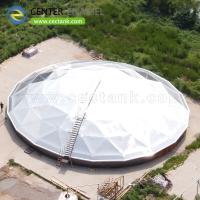
Internal Floating Roofs (IFR): The 2026 Engineering Guide
A Technical Overview of Emission Control, Safety, and Operational
Efficiency
In the modern petrochemical and energy storage industries, managing
volatile organic compounds (VOCs) and ensuring operational safety
is paramount. The Internal Floating Roof (IFR) has become the industry-standard solution for minimizing
evaporative losses in fixed-roof storage tanks. By creating a
physical barrier that rises and falls with the liquid level, the
IFR effectively suppresses vapor formation and ensures
environmental compliance.
This guide provides a comprehensive technical overview of IFR
design, functionality, and the strategic advantages they offer in
2026 infrastructure management.
1. How Internal Floating Roofs Work
An Internal Floating Roof (IFR) operates on the principle of direct
contact. Unlike a standard fixed-roof tank that leaves a large
"vapor space" (ullage) between the liquid and the roof—allowing
vapors to accumulate—an IFR sits directly on the liquid surface.
- Buoyancy-Driven Operation: As the liquid level in the tank rises or falls, the floating roof
moves in tandem. It functions like an engineered raft, requiring no
external power sources, guided purely by the buoyancy of its
structural pontoons.
- Vapor Space Elimination: By maintaining near-continuous contact with the liquid surface,
the roof prevents the liquid from evaporating into a gaseous state,
which is the primary cause of "working losses" in storage tanks.
- Rim Seal Integrity: Because there is a small gap between the edge of the floating roof
and the tank shell, a high-performance rim seal system is installed. This seal bridges the gap, blocking vapor escape
while allowing the roof to slide smoothly along the tank wall.
2. Key Benefits of IFR Technology
Engineering managers and facility operators prioritize IFRs for
their measurable impact on the bottom line and environmental
footprint:
- VOC Emission Reduction: Studies show that IFRs can reduce evaporative losses by up to 95–98% compared to traditional fixed-roof designs, making them essential
for meeting strict air quality and environmental regulations.
- Environmental Protection: By housing the floating roof inside a permanent fixed roof (like
an aluminum geodesic dome), the deck is protected from rain, snow,
and wind. This eliminates the need for complex, high-maintenance
roof drains required by external floating roof (EFR) designs.
- Safety and Fire Mitigation: The IFR eliminates the explosive vapor-air mixture in the tank
headspace, significantly reducing the risk of ignition.
- Operational Savings: Less evaporation means less product lost to the atmosphere,
protecting inventory value, particularly when storing high-value
refined products like jet fuel or chemical solvents.
3. Technical Comparison: IFR vs. EFR
When selecting the right storage configuration, it is important to
distinguish between the two primary floating roof types.
| Feature | Internal Floating Roof (IFR) | External Floating Roof (EFR) |
|---|
| Environmental Exposure | Protected: Housed under a fixed roof. | Exposed: Direct contact with the elements. |
| Maintenance | Lower: No rain/snow accumulation on deck. | Higher: Requires drain and seal maintenance. |
| Emissions Control | Superior: Dual-barrier (dome + deck). | Moderate: Relies heavily on seal integrity. |
| Primary Risk Factor | Seal wear over time. | Sinking (due to blocked roof drains). |
| Typical Use Case | Highly volatile products, harsh climates. | Large-scale crude oil, temperate climates. |
4. Design and Compliance (API 650)
The construction and maintenance of IFRs are governed by
international standards, most notably API 650 (Appendix H). Compliance ensures that:
- Seal Gap Standards: The design must maintain specific gap tolerances between the seal
and the tank shell to prevent fugitive emissions.
- Structural Integrity: The roof must support its own weight, potential snow loads (if the
fixed roof is breached), and localized operational loads without
compromising its buoyant stability.
- Static Control: All IFR systems must include grounding shunts to maintain
electrical continuity between the roof and the tank shell,
preventing the buildup of static electricity.
5. Frequently Asked Questions (FAQ)
Q: Can I retrofit an existing fixed-roof tank with an IFR?
A: Yes. Retrofitting is a highly common practice. Modular IFR
kits—often featuring lightweight aluminum pontoons—are designed to
be passed through standard tank manways and assembled inside,
typically without requiring "hot work" (welding).
Q: Does an IFR need a central drain?
A: Generally, no. Because an IFR is protected by a fixed external
roof (typically a geodesic dome), it is shielded from
precipitation, removing the need for the complex, articulated
drainage systems required by External Floating Roof tanks.
Q: What is the lifespan of an IFR?
A: With proper maintenance and regular inspection of the rim seals
and pontoons, modern aluminum IFRs can provide 20–30+ years of
operational service.
Engineering Authority
Selecting the right IFR technology is a critical infrastructure
decision. Whether you are conducting a new build or an EFR-to-IFR
conversion, ensure your engineering partner adheres to the latest API 650 standards. Proper design, regular inspection of seal integrity,
and adherence to manufacturer guidelines will ensure your facility
maintains maximum safety and environmental compliance for decades
to come.
Would you like to learn more about the different types of rim seals
available for IFRs, such as mechanical shoe seals versus wiper
seals?