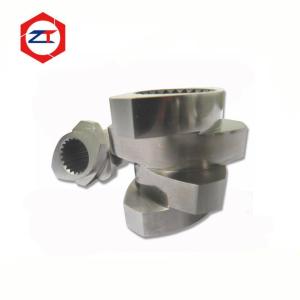
A replacement screw element must do more than match the nominal
extruder size. For an existing 75-class twin screw extrusion line,
the new element must also reproduce the required outside diameter,
three-flighted working profile, length, spline interface, end-face
dimensions and assembly position.
This precision 71mm twin screw extruder screw element is designed for OEM replacement applications where dimensional
consistency and correct assembly fit are critical. The element uses
W6Mo5Cr4V2 / 6542 tool steel and is manufactured with controlled dimensional tolerances to help
maintain compatibility with the existing screw assembly.
For customers replacing only one or several worn elements, accurate
geometry is especially important because the new component must
work correctly with the remaining original elements already
installed on the shaft.
Why Precision Matters in a 71mm Replacement Screw Element
A modular twin screw assembly may contain many individual
conveying, kneading, mixing and transition elements. Each component
is positioned against the next one to form the complete screw
configuration.
If a replacement element has an incorrect length, outside profile
or end-face dimension, the error does not remain isolated to one
component. It can affect the final screw stack, element positioning
and assembly condition.
For this 71mm screw element, the controlled manufacturing
tolerances include:
- Length tolerance: ±0.01 mm
- OD tolerance: -0.03 / 0 mm
- Transition arc tolerance: ±0.02 mm
These controlled dimensions are particularly important for OEM
replacement projects where the new element must fit an existing
screw system rather than a completely new assembly.
Three-Flighted Geometry Must Match the Original Process Position
A three-flighted screw element has a different working geometry
from conventional single- or two-flighted elements.
However, three flights should not automatically be described as
“better” or “higher performance.” The correct geometry depends on
the original screw configuration and the function of the element at
that process position.
For an OEM replacement project, the main objective is to reproduce
the required three-flighted profile accurately so that the
replacement component continues to perform the intended function
within the existing screw design.
Important replacement parameters include:
- Three-flighted profile
- Outside diameter
- Element length
- Lead and pitch
- Transition geometry
- Internal spline interface
- End-face dimensions
- Installation position in the screw configuration
If the original element has already experienced significant wear,
these dimensions should not be copied directly without first
identifying which surfaces have lost material during service.
W6Mo5Cr4V2 / 6542 Tool Steel for Wear-Exposed Applications
The current 71mm element is manufactured from W6Mo5Cr4V2, commonly referred to as 6542 tool steel.
For twin screw extrusion, material selection should always be
connected to the actual operating condition. Wear rate can vary
significantly depending on polymer type, filler content, glass
fiber, mineral additives, screw speed, torque and the location of
the element in the screw configuration.
Tool steel can provide a practical wear-resistant solution for many
compounding applications, but the hardest or most expensive
material is not automatically the correct choice for every
position.
If the existing 6542 element is already providing acceptable
service life, reproducing the original material specification may
be appropriate. If wear is unusually rapid, the process condition
and wear mechanism should be reviewed before simply manufacturing
another identical element.
OEM Replacement Requires More Than a 71mm OD
Nominal outside diameter is only the starting point for
replacement.
A precision OEM replacement screw element should also match:
Working profile → Lead and pitch → Element length → Internal spline
→ End faces → Transition geometry → Position in the screw
configuration
The spline interface is especially important because it connects
the screw element to the shaft and transfers torque through the
modular screw assembly.
If the spline is too loose, excessive clearance can contribute to
movement and interface wear. If it is too tight, installation and
removal can become difficult.
The objective is therefore to reproduce the required spline fit,
not simply to manufacture a component with the same external
appearance.
Why End-Face and Length Accuracy Matter
Multiple screw elements are assembled continuously along the shaft.
This means a small dimensional error in one element can contribute
to accumulated error when many elements are installed together.
Controlled element length and accurately machined end faces help
maintain the designed overall screw stack and correct contact
between adjacent components.
This becomes particularly important when customers replace only
several worn elements while keeping the remaining screw set.
The new parts must integrate into the existing assembly without
creating unexpected gaps, interference or changes in overall stack
length.
Replacing a Worn Element from an Old Sample
An original drawing is the preferred reference for an OEM
replacement, but it is not always available on older extrusion
lines.
An existing screw element can also be measured and used as a
replacement reference.
However, a worn component should not be copied blindly.
Before determining the new manufacturing dimensions, the worn
element should be evaluated to identify:
- Original reference surfaces
- Worn flight surfaces
- Changes in outside diameter
- Spline wear
- End-face condition
- Transition profile wear
Where possible, comparing the worn element with adjacent elements,
the shaft interface or other original dimensional data can help
reconstruct the correct functional geometry.
Can Only the Worn Screw Elements Be Replaced?
In many modular twin screw systems, yes.
If the shaft, barrel and remaining screw elements are still within
acceptable condition, individual worn elements can be evaluated for
replacement instead of automatically replacing the complete screw
set.
The important requirement is dimensional and functional
compatibility.
The replacement element must match the existing shaft spline,
neighboring elements and original process position.
For this reason, we recommend identifying the worn position in the
screw configuration before manufacturing the replacement part.
What Information Is Needed for a Replacement Review?
For an initial evaluation, please provide:
- Extruder model or 75-class machine information
- Existing screw element drawing or sample
- Screw element position in the screw configuration
- Processed polymer and filler information
- Photos of the worn element
- Matching shaft or spline information, if available
If the original drawing is unavailable, the existing element can be
measured after the worn areas have been identified.
FAQ
Is 71mm OD enough to manufacture a replacement screw element?
No. The working profile, element length, pitch, spline, end faces
and transition geometry must also match the existing screw
assembly.
Why is dimensional tolerance important for individual element
replacement?
Because the new element must assemble correctly with existing
neighboring elements. Length or profile errors can affect fit and
total screw-stack dimensions.
Is a three-flighted element always better than a two-flighted
design?
No. Flight number and geometry should match the original process
function and screw configuration. The goal of an OEM replacement is
accurate functional matching rather than changing geometry without
process evaluation.
Can a worn screw element be used as a sample?
Yes. However, the worn surfaces must first be identified so that
service wear is not reproduced in the new element.
Can only one or several worn elements be replaced?
Yes, when the remaining screw set, shaft and barrel are still
suitable for continued use and the replacement elements can be
accurately matched.
Request a 71mm Screw Element Replacement Review
If your 75-class extrusion line has worn three-flighted screw
elements, send us the existing element, drawing or dimensional
information together with its position in the screw configuration.
We can evaluate:
71mm dimensions → Three-flighted profile → Spline interface →
Element length → End-face fit → Material → OEM replacement
compatibility
Send Your 71mm Screw Element Data for OEM Replacement Review